




- Published on: 2026-10-31 10:16:54
Can You Swing Trade and Scalp? Compare the Time and Trade Demands

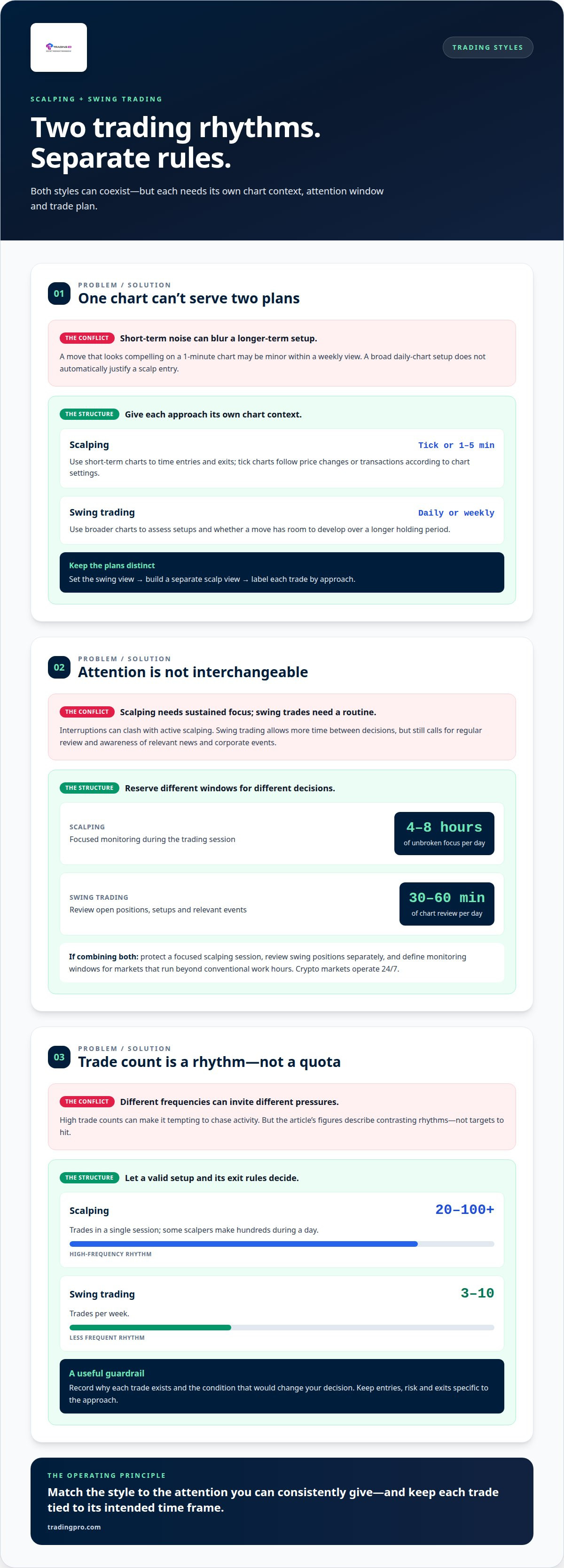
Yes, you can be a swing trader and a scalper, but you’ll need to manage two very different trading rhythms. Scalping often uses tick or 1- to 5-minute charts, while swing trading commonly relies on daily or weekly charts. The real challenge isn’t choosing both; it’s giving each approach the attention and discipline it requires.
It’s easy to see the appeal: scalping involves fast decisions and short holding periods, while swing trades can last days or longer. Combining them may let you pursue different kinds of market moves, but the time commitment, trade frequency, and profit targets differ sharply. A plan that works for one style won’t automatically work for the other.
This comparison covers chart time frames, monitoring demands, trade frequency, targets, and holding periods, helping you judge whether both styles fit your schedule and approach to risk. You’ll also find a practical way to choose one style or keep both strategies separate.
Key Takeaways
- You can combine both styles, but separate rules for entries, risk, and exits help keep each approach disciplined.
- Match your trading style to the attention you can consistently give the markets, not just the moves you hope to capture.
- Compare trade frequency and target size to understand how each style approaches opportunity and transaction costs.
- Use holding periods to decide whether you prefer quick, active sessions or positions that develop over a longer stretch.
- Choose an account structure that aligns with your trading approach and the pace you intend to follow.
Chart time frames
Chart choice sets the pace of a trade. Scalpers commonly use tick charts or 1- to 5-minute charts, where each move can demand a quick decision. Swing traders commonly use daily or weekly charts to assess broader price movements. These time frames support different plans, so combining both styles works best when each trade has its own chart context.
A lower-time-frame chart shows short-term price changes in detail. For example, a scalper may watch a 1-minute chart to identify an entry and manage a rapid exit. Tick charts display each price change or transaction according to the chart’s settings, rather than advancing at fixed minute intervals. These views can help with precise timing, but small fluctuations can distract from a clear plan if every movement triggers a response.
Daily and weekly charts show more price action in each bar. A swing trader can use them to assess whether a move has room to develop over a longer holding period. For example, a pullback on a daily chart may fit a broader trend visible on a weekly chart. The focus is not on reacting to every intraday fluctuation, but on whether the larger setup remains intact.
| Trading approach | Common chart time frame | Primary use | Typical focus |
|---|---|---|---|
| Scalping | Tick or 1- to 5-minute charts | Time entries and exits | Short-term price movement |
| Swing trading | Daily or weekly charts | Assess broader setups | Price movement over a longer horizon |
Can I be a swing trader and a scalper? Yes, if you keep each strategy tied to its own chart context and trade plan. Use this structure to separate them:
- Set the swing view. Use daily or weekly charts to identify the broader setup and the conditions that would invalidate it.
- Build a separate scalp view. Use a tick chart or 1- to 5-minute chart to assess a short-term opportunity, with its own entry and exit plan.
- Label each trade by approach. Record whether the idea comes from a scalp or swing setup, so a quick trade doesn’t quietly become a longer hold.
If you’re still deciding whether you can be a swing trader and a scalper, start by matching each trade to its intended holding period. A move that looks compelling on a 1-minute chart may be minor within a weekly view. Conversely, a broad daily-chart setup doesn’t automatically justify a scalp entry. Choose the chart time frame that fits the plan you intend to manage.
Monitoring requirements
Scalping demands attention throughout the trading session, not occasional chart checks. Active scalping can require 4-8 hours of unbroken focus per day. A scalper watches for short-term changes, evaluates entries quickly, and manages open trades without long gaps. If work calls, a meeting interrupts, or concentration slips, the strategy’s monitoring demands may clash with the day.
Swing trading leaves more room between decisions, but it still needs a consistent routine. Reviewing charts for 30-60 minutes per day can help a swing trader assess open positions and potential setups. The trader also needs current information about relevant news and corporate events. For example, a company announcement may affect the reasoning behind a stock position, so scheduled review matters even when a trade isn’t close to its exit.
Set the routine around the decisions each style requires:
- Scalping: Stay focused throughout the trading session, respond promptly to developing setups, and monitor open positions closely.
- Swing trading: Schedule a daily review, note relevant news or corporate events, and reassess whether each position still fits its plan.
- Both approaches: Keep a written record of the reason for each trade and the condition that would change your decision.
Running both styles means protecting the attention each requires. For example, you might reserve a focused session for scalping, then review swing positions separately later. This helps prevent a fast-moving scalp from competing with a longer-term decision. If you can’t give a scalp your attention, don’t treat it as a swing trade by default.
Consider your market’s schedule, too. Crypto markets operate 24/7, so price movement can continue beyond conventional work hours. That doesn’t mean a trader must watch every moment. It does mean a plan needs clear monitoring windows and rules for managing positions when the trader steps away. For other markets, align the scalping session with the hours you can consistently focus.
Before combining styles, map out a typical day. Mark the time reserved for active scalping, the daily window for reviewing swing trades, and any commitments that could interrupt either routine. If the schedule leaves no uninterrupted focus for scalping, prioritize the approach you can monitor reliably. A trading account registration can be a next step once you’ve defined that routine and know which trading pace fits your day.
Scalping suits people who can devote time to markets, stay focused, and act quickly. Consider that commitment when deciding whether the routine is sustainable for you.
Number of trades
Trade count is one of the clearest differences between scalping and swing trading. Scalpers may execute 20-100+ trades in a single session, and some make hundreds during a day. Swing traders typically place 3-10 trades per week. Those figures describe different rhythms, not a target you must hit. A valid setup and its exit rules should determine whether you trade, not a daily quota.
In the United States, FINRA defines a pattern day trader as an investor who executes four or more day trades within five business days, when those trades represent more than 6% of all trades during a full business week. A pattern day trader must maintain at least $25,000 in a margin account on any day they trade; cash or securities can meet the minimum. If equity falls below $25,000, trading must stop until the minimum balance is restored.
That rule makes trade classification and account equity relevant for frequent stock scalping. It doesn’t mean every scalper automatically meets the pattern day trader test: both the number of day trades and their share of total trades matter. Swing trades held beyond the trading day don’t count as day trades simply because they’re frequent. Keep accurate opening and closing times, especially when mixing same-day scalps with longer positions.
Can I be a swing trader and a scalper while keeping trade activity under control? Yes, but separate trade records help reveal whether each entry follows its own setup. For example, a scalper taking 20 trades can record each setup and outcome, then assess the group. A swing trader placing 3-10 weekly trades can review each position’s rationale, planned exit, and response to new information.
Use a simple tracking routine to keep the two styles distinct:
- Label each trade: Record “scalp” or “swing” before entry, then track it against the matching plan.
- Count completed trades: Separate opened positions from closed trades, and note which opened and closed on the same day.
- Review by strategy: Compare results for each approach separately instead of blending their trade counts.
If you’re asking, “Can I be a swing trader and a scalper?” don’t let a quiet swing-trading week push you into extra scalps. Likewise, don’t let a busy scalp session distract you from managing an existing swing position. Set activity criteria for each style and pause when trades no longer meet them. Tracking this helps you spot when activity, rather than a valid setup, is driving decisions.
Profit targets
Scalpers pursue small, repeated price moves, while swing traders aim for fewer, larger moves. A scalping target commonly falls around 2-10 pips per forex trade, or approximately 0.1-0.5% per trade. Swing traders may target 50-300 pips per forex trade. For stocks and crypto, swing targets may instead focus on price moves of 3-10%. These ranges describe different approaches, not guaranteed outcomes.
The smaller the scalp target, the more each transaction cost can matter. For example, a 1.5-pip spread on a trade targeting 5 pips equals 30% of that target. The price must move enough to cover the spread before the trade reaches its gross target. That makes cost awareness especially important when repeated trades each seek a narrow move. A larger swing target gives costs a different proportion, but doesn’t remove their effect.
Scalpers often exit as soon as a position becomes profitable, aiming to capture small gains across separate setups. Swing traders generally seek fewer, larger targets and may give a position more room to develop. Neither approach should rely on a target alone. The entry, invalidation level, position size, and exit plan determine how much potential reward justifies the risk.
A risk-to-reward plan helps compare possible gains with planned losses. For example, a swing setup using a 1:3 risk-to-reward target aims to make three units for each unit risked. At a 40% win rate, that example can still be profitable before costs: the winning trades’ planned gains can outweigh losses if the plan is followed. Actual results depend on execution, costs, and whether trades reach their planned exits.
Keep the target rules separate when using both styles:
- For a scalp, set a modest target suited to the short-term setup, then exit according to the plan rather than stretching for a larger move.
- For a swing trade, define a broader target and the condition that would invalidate the setup before entering.
- For both, record planned reward, potential loss, and transaction costs, then review results by strategy.
Don’t compare a 5-pip scalp directly with a 50-pip swing target as if the larger figure alone makes one strategy better. Each target belongs to a different trade horizon and decision process. Test whether your target matches the setup, accounts for costs, and supports a consistent risk plan. If you combine styles, label each trade and assess its results against its own target rules.
Scalping and swing trading holding periods
Scalping positions are typically held for seconds to a few minutes. Swing trades commonly last a few days, but can extend to weeks or months. That difference changes how you manage each position: a scalp calls for a quick exit decision, while a swing trade needs a plan for holding through ordinary price movement. In trending markets, major cryptocurrencies can move 10-30% during a 2-3 week holding period.
For U.S. taxes, the trading label alone doesn’t determine tax treatment. Asset type, account type, realized gains or losses, and holding period are relevant details to track for tax reporting.
Practical account-size estimates differ by style and market: scalping is often associated with $10,000+ USD, while swing trading forex and crypto is associated with $2,000-$5,000 USD. These are practical minimum estimates, not a promise that a particular balance suits every strategy.
You can use the same stock and trading account for scalping and swing trading while keeping each position’s plan distinct. For example, record whether a stock position is a short-term scalp or a longer swing, and avoid changing its intended holding period impulsively.
Manage combined risk by setting a separate entry, exit, and invalidation point for each trade. Also track overlapping positions: a scalp and swing position in the same stock can both be affected by a sharp price move. Review your total exposure before adding another trade.
The main challenge is switching between fast scalp decisions and slower swing management. Conflicting exit plans, divided attention, overlapping exposure, and repeated transaction costs can undermine execution. For instance, turning a losing scalp into a swing trade changes the original plan and risk profile.
Use this routine to keep both approaches organized:
- Before entry: Label the position “scalp” or “swing” and write its planned exit.
- During the trade: Follow that position’s rules instead of borrowing the other strategy’s time frame.
- After closing: Record the result, holding period, and whether you followed the plan.
Build a clear process before putting both styles into practice. Register for a trading account when you’re ready to put your approach into action.
Decision-making is another key difference: scalping requires rapid decisions, while swing trading allows a more fluid process. The page characterizes scalping as extreme and swing trading as moderate. It also says scalping is not for novice traders, while swing trading is suitable for beginners, moderate traders, and advanced traders. Consider whether each style’s demands fit your experience and available time, rather than choosing solely by how long a position lasts.
For stock scalping, the page identifies the first 30-90 minutes after the NYSE open as a high-volume period. Scalping requires constant monitoring throughout the trading session, so its demands extend beyond making a quick entry or exit. Swing trading requires reasonable monitoring and up-to-date information on news and corporate events. That different monitoring schedule may make it easier to manage alongside other responsibilities, but it still calls for attention to relevant developments. Consider the decision pace, strategy intensity, experience level, and monitoring needs together when deciding how to organize your trading activity.
TradingPRO: Rookie Account
TradingPRO’s Rookie Account is one account option to consider as you put a trading approach into practice. First decide whether your routine fits swing trades, scalps, or a carefully separated mix, then choose an account tier that aligns with your direction. The Micro Account, Pro Account, and Scalp Account are other options to explore as you define your trading style.
Keep your plan in focus by setting distinct rules for entries, exits, and risk before combining strategies. If your approach centers on scalping, compare the Scalp Account with your needs. If you’re still establishing your preferred pace, explore the Rookie Account and consider how it fits your plan.
Visit tradingpro.com to explore TradingPRO’s account options.
Build a trading approach you can sustain
If you’re asking whether you can be both a swing trader and a scalper, focus on building a process you can follow consistently. Choose which style to prioritize first, write down the rules that guide your decisions, and review your execution before adding complexity. A deliberate approach makes it easier to see whether the two styles work together or compete for your attention.
TradingPRO’s Rookie Account, Micro Account, and Pro Account offer options to consider as you shape your trading approach. Choose the account that aligns with how you plan to trade, then keep refining your process around your goals and discipline.
Explore TradingPRO account options and take your next step with a clear plan. Build steadily, stay focused, and move forward with confidence.
Frequently Asked Questions
Can I Swing Trade or Scalp Trade for a Living?
Both swing trading and scalping can be pursued full-time and may provide a living, but neither guarantees income. Assess results after trading costs and compare them with your financial needs before relying on trading as a livelihood. A profitable period alone doesn’t show that a strategy can support you through changing market conditions. Track performance consistently, including losing trades and periods when your setup produces no entry.
Can you swing trade and scalp at the same time?
Yes, you can manage both approaches at the same time if you keep their rules distinct. For example, a swing position can follow a multi-day thesis while a separate scalp has its own entry and exit plan. Don’t let a quick trade change your view of the longer position without a reason. A trade journal that labels each position by strategy makes it easier to review decisions and spot conflicts between your rules.
What are the key differences between swing trading and scalping?
The core difference is how each approach turns a market view into a decision. A scalp depends on frequent, quick execution, so hesitation can affect the planned exit. A swing trade gives a broader thesis more time to develop, making patience and reassessment central. For instance, a short-term price reversal may end a scalp plan while leaving a separate longer-term thesis unchanged. Judge each position by its own criteria.
How much time per day does scalping require compared with swing trading?
Active scalping can require 4-8 hours of unbroken focus per day, while reviewing swing-trading charts may take 30-60 minutes per day. Treat these as different scheduling demands: a scalp session needs sustained attention, while swing reviews can fit into a planned daily routine. For example, if meetings interrupt your focus, reserve them outside an active scalping session and keep a separate review window for swing positions.


