




- Published on: 2026-09-16 16:51:52
High Risk vs Low Risk Copy Portfolios: The 2026 Strategy Guide

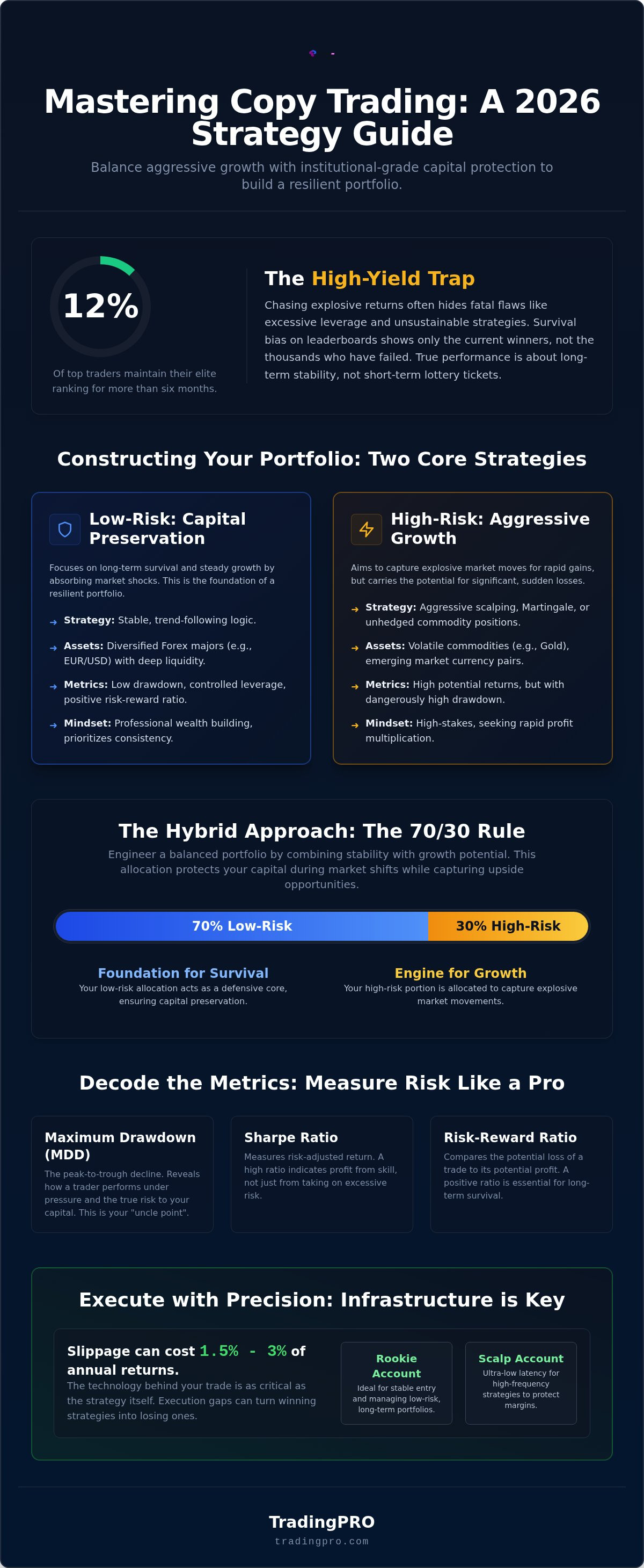
Only 12% of top-performing master traders maintain their elite ranking for more than six months. If you're blindly following the leaderboard, you aren't investing; you're gambling on a ticking clock. It's exhausting to battle analysis paralysis while your capital sits between stagnant low-interest savings and the gut-wrenching volatility of unmanaged trades. You deserve a strategy that delivers peak performance without the constant fear of a "black swan" wipeout.
This 2026 strategy guide empowers you to master the art of replication by balancing aggressive growth with institutional-grade capital protection. You'll learn exactly how to construct high risk vs low risk copy portfolios that leverage precision execution and sophisticated risk management. Whether you're utilizing a Rookie account for stable entry or a Scalp account for high-frequency momentum, the goal remains the same: consistent, scalable success. We provide the clear framework you need to categorize traders and configure your settings with absolute confidence. We'll explore the mechanics of portfolio diversification, the reality of active management, and the specific settings required to protect your legacy in a fast-moving market.
Key Takeaways
- Identify the 'High-Yield Trap' and learn why chasing extreme returns often leads to catastrophic account drawdowns.
- Master the construction of high risk vs low risk copy portfolios by precisely categorizing strategies like aggressive scalping versus stable trend-following.
- Implement the 70/30 rule to balance long-term survival with explosive growth, ensuring your capital remains protected during sudden market shifts.
- Select the optimal entry point using TradingPRO's tiered infrastructure, ranging from low-barrier Rookie accounts to high-performance Scalp accounts.
The Social Trading Dilemma: Yield vs. Stability
The social trading feed is a high-stakes arena where 1000% returns act as a siren song for the unwary. It's easy to be blinded by explosive growth charts, but these numbers frequently hide fatal structural flaws. This is the High-Yield Trap. It occurs when a trader uses excessive leverage or dangerous strategies to manufacture short-term gains that are statistically impossible to maintain. From an institutional perspective, stability is the only competitive edge that matters. Professional wealth building isn't about the biggest win today; it's about the ability to execute tomorrow.
Successful copy trading in 2026 demands a shift from passive observation to aggressive strategy management. As market volatility increases, your ability to distinguish between high risk vs low risk copy portfolios becomes your primary defense. You need a framework that prioritizes capital preservation as much as profit potential. This isn't just about picking traders; it's about engineering a portfolio that survives the inevitable shifts in global liquidity.
The Psychology of Chasing Gains
Survival bias heavily distorts the social trading leaderboard. You only see the winners who haven't blown up yet, not the thousands who vanished last week. Research indicates that only 12% of top traders maintain their ranking for more than six months. This creates a lottery ticket mentality among beginners who treat the markets like a casino rather than a business. High-performance trading requires a mentor's mindset. Beginners often fail because they select high-risk strategies without the infrastructure of a Rookie account or the execution speed of a Scalp account to manage the fallout.
The Reality of Drawdown
Drawdown is the only metric that truly reveals a trader's soul. While profit tells you what happened when things went right, drawdown tells you what happens when the market turns. Drawdown is the maximum peak-to-trough decline in a specific period. Low-risk portfolios are engineered to absorb these shocks through diversified FX majors and trend-following logic. High-risk portfolios, often relying on Martingale or unhedged gold positions, can vanish in a single afternoon. Balancing high risk vs low risk copy portfolios is the only way to ensure your capital survives a black swan event while still capturing explosive market moves.
Decoding the Metrics: How to Measure Portfolio Risk
Metrics are the pulse of your trading strategy. Without them, you're flying blind in a hurricane. Leverage ratios represent the most potent double-edged sword in high-performance trading. While high leverage can accelerate growth, it also amplifies every market tremor. When evaluating high risk vs low risk copy portfolios, look beyond the surface-level profit. A master trader with a 90% win rate might seem invincible, but if their average loss is ten times larger than their average win, they're one bad day away from insolvency. You need a positive risk-reward ratio to ensure long-term survival. Consistency in 2026 is built on mathematical certainty, not luck.
Asset class selection dictates your baseline volatility. Trading Forex majors like EUR/USD offers institutional stability and deep liquidity. Conversely, emerging market pairs or high-volatility commodities introduce wild swings and wider spreads. The frequency of execution also shifts your risk profile. High-frequency scalping strategies require lightning-fast precision to capture micro-movements, while position trading demands patience and a sophisticated plan for asset allocation across different market cycles. Both require a deep understanding of how volatility impacts your equity and your peace of mind.
Technical Indicators of Risk
The Sharpe Ratio is your primary tool for measuring risk-adjusted returns like a professional. It tells you if a trader's profit is a result of genuine skill or simply taking on excessive heat. Maximum Drawdown (MDD) is equally critical. It defines your 'uncle point', the specific percentage of capital loss that triggers a strategy review or total exit. Don't ignore trade duration. Overnight swaps and rollover fees can silently erode the margins of low-risk, long-term portfolios. Monitoring these technical data points ensures your high risk vs low risk copy portfolios remain within your personal comfort zone while aggressively pursuing growth.
Infrastructure and Execution Risk
Risk isn't just about strategy; it's about the technology behind the trade. Slippage can reduce gross annual returns by 1.5% to 3% in high-volatility environments. This execution gap turns a winning strategy into a losing one for the follower. Utilizing a Scalp Account provides the ultra-low latency needed to protect your margins from these micro-delays. High-frequency copy strategies are particularly sensitive to spreads and execution speed. You must understand how automated portfolio replication handles these gaps to maintain your competitive advantage. Precision execution is the final barrier between a successful portfolio and a failed experiment. You can secure your professional trading access to begin configuring your risk parameters with institutional-grade tools.
High Risk vs. Low Risk: A Side-by-Side Comparison
Choosing between high risk vs low risk copy portfolios isn't a matter of right or wrong. It's a matter of objective and infrastructure. High-risk strategies are designed for velocity, while low-risk portfolios prioritize longevity. In the fast-moving landscape of 2026, the most successful investors aren't just picking one or the other. They're categorizing their master traders based on execution style and capital requirements to build a resilient machine. High-risk execution often involves aggressive scalping, Martingale systems, or high-leverage gold trading. Conversely, low-risk strategies lean on trend-following, carry trades, and diversified FX majors to deliver steady results.
Capital requirements vary wildly between these two extremes. High-risk strategies demand a significant buffer to survive temporary heat, while low-risk portfolios require the patience to let compounding work its magic. This strategic balance helps you reduce your overall risk while maintaining exposure to market upside. By 2026, AI-driven signals have begun narrowing the gap, allowing for more precise entries even in aggressive setups.
High Risk: The Aggressive Growth Engine
Aggressive setups are built for traders who value speed and significant upside. They're ideal for small accounts looking to scale fast using Micro accounts. These strategies often push 'Stop Out' levels to the limit to capture massive market swings. When managing high risk vs low risk copy portfolios, understanding these thresholds is mandatory. Consider a case study of a $100 deposit: by utilizing high-frequency signals and aggressive leverage on a Micro account, a trader can target rapid growth that traditional savings models simply cannot match. However, this engine requires constant monitoring and a willingness to accept higher volatility in exchange for peak performance.
Low Risk: The Wealth Preservation Vault
Low-risk portfolios act as a secure vault for your capital. They're the preferred choice for large allocations and those seeking consistent, long-term passive income. The power lies in compounding 2-5% monthly returns. Over time, this steady growth outperforms erratic high-yield gambles. Low-risk execution is the backbone of any institutional grade trading environment. It focuses on survival first. By copying traders who prioritize trend-following and FX majors, you ensure your portfolio remains stable even when global markets face sudden liquidity shifts.
The Hybrid Approach: Engineering a Balanced Copy Portfolio
Professional capital management isn't about choosing a single path. It's about engineering a hybrid model that maximizes growth while maintaining a safe-haven foundation. You shouldn't settle for mediocre returns or reckless gambles. Instead, adopt the 70/30 Rule. Allocate 70% of your equity to institutional-grade, low-risk anchors and 30% to high-octane satellites. This strategic balance ensures you survive market shocks while capturing explosive alpha. Mastering the blend of high risk vs low risk copy portfolios is what separates the veterans from the amateurs.
Diversification by strategy is non-negotiable. Never copy two traders with identical logic. If both masters use Martingale setups on Gold, a single liquidity crunch will wipe you out. Combine a trend-following master with a high-frequency scalper to ensure your returns aren't correlated. Set a 'Global Stop-Loss' at the portfolio level to act as your ultimate circuit breaker. This institutional-grade protection prevents a single trader's mistake from compromising your entire balance. By 2026, sophisticated AI signal filtering has made it easier to spot high-probability entries, allowing you to run aggressive satellite strategies with more precision than ever before.
Step-by-Step Portfolio Construction
First, identify your anchor. Select a 'Low Risk' master trader with at least two years of verified history. This is your foundation. Next, select your satellites. Add one or two 'High Risk' traders to provide the necessary growth engine for your account. Always calculate your aggregate leverage across all copied trades to avoid over-exposure. This modular approach allows you to scale your ambition without sacrificing your security. You're building a machine designed for peak performance in any market condition.
Monitoring and Optimization
Perform weekly health checks to spot style drift. If a low-risk master suddenly increases their position sizing or trade frequency, they've abandoned their core logic. Use the Trade Hub to monitor your real-time exposure and adjust your settings instantly. It's essential to rebalance your portfolio every 30 days to maintain risk parity and lock in growth. Harvesting gains from high-risk satellites and moving them into your low-risk anchors is how you build sustainable wealth. Stop letting indecision stall your progress. Register your professional account today and start engineering your hybrid portfolio with precision.
Execute with Precision: Launching Your Portfolio on TradingPRO
Execution is where strategy meets reality. You've mapped your 70/30 split and identified your master traders. Now, you need the infrastructure to deploy it. TradingPRO provides the high-performance ecosystem required to manage high risk vs low risk copy portfolios with surgical precision. Our frictionless social feed allows you to filter master traders in real-time, while our lightning-fast replication engine ensures you never miss a move. This is about more than just following; it's about leading your capital toward peak performance with the best tools in the industry.
Boosting your margin is a tactical necessity in the 2026 market. By leveraging the Deposit Bonus, you increase your margin safety net. This provides the essential breathing room needed for aggressive satellite strategies to operate without triggering premature stop-outs. You remain in total command of every cent. Whether you need to pause a specific copier, edit a trade's parameters, or exit a position in seconds, our platform puts the power in your hands. Precision is the difference between a winning portfolio and a missed opportunity.
The Rookie Account Advantage
The Rookie Account is the ultimate 'Low Risk' testing ground for your strategy. It's built specifically for those who value stability and low-barrier entry. Zero-fee structures ensure that your gains stay in your pocket, directly impacting the speed of your small-balance compounding. Use this tier to verify the consistency of your anchor traders before scaling up. It's the smartest way to balance high risk vs low risk copy portfolios without exposing your entire balance to day-one volatility. Open your Rookie Account and start copying today.
Scaling for the Pros
When you're ready to target high-frequency alpha, move to the Scalp Account. This is where institutional-grade execution becomes your standard. We've engineered this tier to minimize the 'copy lag' that often kills profits in high-volatility environments. By reducing slippage and providing elite-tier execution speeds, the Scalp Account ensures your high-risk satellites perform exactly as intended. This is the choice for traders who demand perfection and refuse to settle for delays. Join the elite at TradingPRO and dominate the markets.
Master Your Market Execution
Market success in 2026 isn't about luck. It's about engineering. You've learned to leverage the 70/30 rule to balance explosive alpha with institutional stability. By categorizing master traders and monitoring drawdown, you've moved beyond the High-Yield Trap into professional wealth building. Mastering high risk vs low risk copy portfolios is the final step in securing your financial legacy.
You now possess the framework to deploy a hybrid model that survives volatility and captures momentum. TradingPRO acts as your sophisticated partner, offering a multi-regulated global environment and a dedicated social trading ecosystem. Our institutional-grade execution speeds ensure your replication is frictionless. Whether you're using a Rookie account for stability or a Scalp account for high-frequency growth, the advantage is yours.
Secure your trading future-Register for a TradingPRO account now
Your journey toward consistent, scalable growth starts with a single, decisive action. Take command and dominate the markets today.
Frequently Asked Questions
Is high-risk copy trading just gambling?
High-risk copy trading is a calculated strategy, not a roll of the dice. While it involves higher volatility, professional traders use technical metrics like the Sharpe Ratio and Maximum Drawdown to manage probability. You aren't betting on luck; you're backing a specific execution logic that targets rapid growth. By treating these high-performance strategies as a satellite component of your broader portfolio, you turn market volatility into a powerful tool for aggressive capital expansion.
What is the minimum deposit for a low-risk copy portfolio?
The minimum deposit depends on your chosen account tier and the specific master trader's requirements. TradingPRO offers low-barrier entry through Rookie and Micro accounts, making it accessible for everyone. However, a low-risk portfolio needs enough capital to mirror the master's position sizing accurately. Check each trader's profile for their recommended minimum to ensure your account has the margin required for institutional-grade stability and consistent execution without hitting margin calls.
How do I protect my account from a master trader's sudden loss?
Protection starts with setting global stop-loss limits at the portfolio level. This acts as a circuit breaker if a master trader's strategy fails. You should also use risk multipliers to scale down the trade size relative to your equity. Diversifying across high risk vs low risk copy portfolios ensures that a single drawdown doesn't compromise your entire balance. Constant monitoring via the Trade Hub is your best defense against unexpected market shifts.
Can I copy multiple traders on a single TradingPRO account?
Yes, our social trading ecosystem is built for multi-trader replication. You can follow several master traders simultaneously to create a balanced, hybrid portfolio. This allows you to combine different strategies, such as trend-following and scalping, under one roof. Managing multiple traders from a single dashboard simplifies your oversight and helps you maintain risk parity across your entire capital allocation. It's a powerful way to build a resilient and diversified trading machine.
Should I use a Rookie or a Scalp account for social trading?
The choice depends on your strategy and experience. The Rookie account is the perfect low-risk testing ground for beginners or those testing new master traders. If you're targeting high-frequency replication with minimal execution lag, the Scalp account is the professional choice. It offers institutional-grade speeds that are critical for aggressive satellites where every millisecond counts. Match your account tier to the execution demands of your chosen traders to maximize your results.
What happens if my master trader uses higher leverage than I have available?
The replication engine scales positions proportionally based on your available equity and leverage settings. If the master trader uses leverage that exceeds your account limits, the system will attempt to open a smaller position to stay within your parameters. In some cases, the trade might not execute if the margin requirement isn't met. It's vital to align your account leverage with your master traders to ensure frictionless replication and avoid missed opportunities.
How often should I withdraw profits from a high-risk portfolio?
We recommend a monthly rebalancing cycle for optimal performance. Harvesting gains every 30 days allows you to secure profits from high-risk satellites and move them into low-risk anchors. This disciplined approach protects your capital from being wiped out during a sudden market shift. Regular withdrawals or transfers ensure you aren't just building paper wealth but are actually growing your realized equity through smart management. Consistency is the hallmark of a professional trader.
Does TradingPRO offer negative balance protection for copied trades?
Yes, TradingPRO provides negative balance protection for all clients, including those engaged in copy trading. This ensures that your losses will never exceed your initial deposit, even during extreme market volatility or black swan events. This safety net provides the confidence needed to explore high risk vs low risk copy portfolios without the fear of owing money beyond your account balance. It is a cornerstone of our commitment to institutional-grade security and reliability.


