



- Published on: 2026-10-29 06:10:25
How to Check If a Broker Is Regulated and Review Their Record

A broker’s polished profile is not proof of registration. In the United States, how to check if a broker is regulated starts with searching for the broker or firm in FINRA BrokerCheck, then reviewing registration details and disclosures. For investment advisers, search the SEC’s Investment Adviser Public Disclosure website or contact your state securities regulator.
Before making an investment decision, verify credentials and review the professional’s record. This guide explains how to search by name or CRD number, confirm where a broker is registered, and assess customer disputes and disciplinary disclosures. You’ll also learn what BrokerCheck can tell you, when to use IAPD, and how to interpret the records so you can make an informed decision.
Key Takeaways
- Use FINRA BrokerCheck to review a broker’s registration, employment history, qualifications, and disclosures.
- Search by the broker’s name or CRD number, then confirm the record matches the person and firm you’re assessing.
- Check customer disputes and disciplinary records carefully; understand what each disclosure says before drawing conclusions.
- For investment advisers, consult IAPD and your state securities regulator to examine registration and background information.
- Broker-dealer firms and investment advisers use different registration records, so choose the database that fits the professional you’re checking.
Why to investigate brokers and investment advisers
- Before transferring money, identify the professional and the service they provide. In the United States, state and federal laws require brokers, investment advisers, and their firms to be registered or licensed. An unregulated broker may not have the registration status required for the activities they offer. You may also have less public information available about their employment, qualifications, or disciplinary history.
Verification is a practical first step, not a substitute for evaluating an investment. A registration record helps you compare the person, firm, and activity involved. If a broker also offers investment advice, check the adviser records.
- Search FINRA BrokerCheck for a stockbroker or brokerage firm. BrokerCheck also provides basic information about investment adviser firms and representatives from the SEC’s Investment Adviser Public Disclosure database, with links to IAPD for more detail. Use the results to identify the right professional and firm before reviewing their records.
A FINRA member’s website must display a readily apparent BrokerCheck reference and hyperlink on its initial webpage for retail investors, as well as on pages profiling registered people who serve retail investors. This is a FINRA requirement. Treat the reference as a starting point, then review the underlying record.
- For an investment adviser, open the Investment Adviser Public Disclosure website, commonly called IAPD. It provides information about adviser firms and representatives registered with state securities regulators and the SEC. Search both the firm and the individual representative when both are involved.
Review the firm’s Form ADV and the adviser representative’s information associated with the record. Match the names and firm details to the person offering advice. A similarly named business or representative can lead to a misleading match, so compare identifying details before relying on a result.
- Use IAPD and the Investment Adviser Registration Depository, or IARD, to look beyond one adviser’s name. IARD holds information on more than 260,000 investment advisers. Its records help investors research the employment and disciplinary histories of nearly 31,000 adviser firms and more than 350,000 individual adviser representatives.
These records help distinguish a firm’s history from a representative’s history. Read each record separately. A firm record does not automatically describe everyone associated with it, and an individual’s record does not replace checking the firm.
- Compare the database result with the exact professional, firm, and service presented to you. Save the record details and note any differences in names, registration information, or employment history. If an entry raises questions, contact your state securities regulator before giving money to a broker or investment adviser.
FINRA BrokerCheck and IAPD support related but distinct searches. Use BrokerCheck for broker and brokerage information, and IAPD for investment adviser firms and representatives. Reviewing the relevant records gives you a clearer basis for further research.
Checking customer disputes and disciplinary disclosures
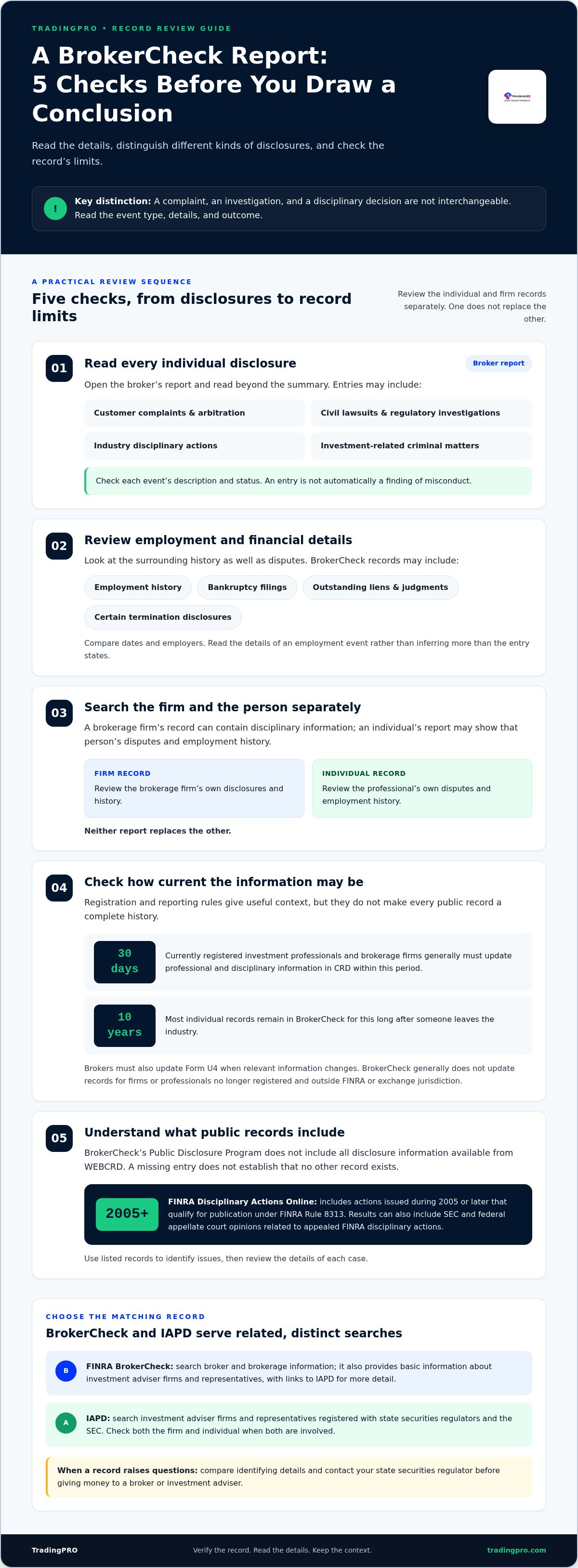
Broker licenses and registrations indicate a professional’s recorded qualifications and registration status; disclosures report specified events in their history. Review the type and outcome of each entry, because a complaint, an investigation, and a disciplinary decision are not interchangeable.
- Open the individual broker’s BrokerCheck report and read every disclosure, not just the summary. Records can include customer complaints, arbitration proceedings, civil lawsuits, regulatory investigations, and industry disciplinary actions. They may also report criminal matters involving investment-related misdemeanors or felonies.
Check the event description and status. A customer dispute is different from a regulator’s disciplinary action, so don’t treat every entry as a finding of misconduct.
- Review employment and financial disclosures alongside disputes. BrokerCheck records may include employment history, bankruptcy filings, outstanding liens, judgments, and termination following misconduct allegations or failure to supervise subordinates.
Compare dates and employers across the report. A termination disclosure, for example, records a reported employment event. Read its details rather than inferring more than the entry says.
- Search the brokerage firm’s report separately from the individual’s report. Firm records can contain disciplinary information, while an individual’s report may show that person’s disputes and employment history. Neither record replaces the other.
For eligible cases and actions, FINRA Disciplinary Actions Online includes actions issued during 2005 or later that qualify for publication under FINRA Rule 8313. Its results can also include SEC and federal appellate court opinions related to appealed FINRA disciplinary actions.
- Check how current the record appears. Currently registered investment professionals and brokerage firms generally must update professional and disciplinary information in CRD within 30 days. Brokers must also update Form U4 when relevant information changes, including disclosures, job changes, or financial events.
Most individual records remain in BrokerCheck for 10 years after someone leaves the industry. BrokerCheck generally doesn’t update information about firms or professionals no longer registered and outside FINRA or exchange jurisdiction.
- Understand the limits of a public report before treating it as a complete history. FINRA’s Public Disclosure Program does not include all disclosure information available from WEBCRD. A missing BrokerCheck entry therefore does not establish that no other record exists.
Use the report to identify issues, then review the details of any listed case. FINRA Disciplinary Actions Online supports searches by individual or firm name, case number, date range, document type, document text, or CRD number. Compare identifying details before drawing conclusions.
BrokerCheck records can include employment history, disciplinary actions, professional designations, securities-dispute judgments and arbitrations, bankruptcy filings, and outstanding liens. FINRA BrokerCheck reports whether an individual broker has been subject to industry disciplinary actions or regulatory investigations, and whether the broker has been charged with or convicted of criminal felonies or investment-related misdemeanors. It also reports whether an individual broker has been involved in investment-related civil actions or proceedings, consumer complaints, arbitration proceedings, or civil lawsuits. Read each entry to understand what was alleged, decided, or recorded; the presence of a category alone is not a conclusion about the broker.
State securities regulators
- Identify the state securities regulator connected to the broker or adviser. State regulators provide registration, employment, and disciplinary information about stockbrokers and investment advisers. Start with the state where the professional works, then compare the regulator’s record with the person’s firm and stated role.
Use the regulator’s information to check licensing and registration in context. A broker’s record and an investment adviser’s record may appear in different systems. Match the professional’s name and firm carefully, especially when names are common or similar.
- Contact the relevant regulator directly if an online search leaves a gap. Investors can verify a broker or adviser license through a state securities regulator, BrokerCheck, or the Investment Adviser Public Disclosure website. Ask about the registration information for the exact individual or firm instead of relying on a marketing claim.
Make your inquiry specific: provide the professional’s full name, firm name, and the service they offer. This helps distinguish a broker from an adviser and reduces the chance of confusing similarly named records. Keep the regulator’s response with your research notes.
- Use IAPD to cross-check investment adviser records. The Investment Adviser Public Disclosure system is a joint project of the SEC, state securities regulators, and FINRA. Search the adviser firm and its representatives, then compare the results with state regulator records.
BrokerCheck information is based on WEBCRD, a joint registration data system used by the SEC, state securities regulators, and FINRA. These systems support licensing and registration research, but serve different searches. Choose the database that matches the professional’s role.
- If you’re in Texas and can’t find an adviser registration record, use the state-specific process. The Texas State Securities Board accepts requests for nonconfidential information available from WEBCRD by email at [email protected].
Keep the request focused on the adviser’s identity and the record you’re trying to locate. The Texas example shows why a missing online result should prompt a direct state-level inquiry, not an assumption about the person’s status.
- Before proceeding, compare the state record with the professional’s claims and the relevant federal or industry database. Look for consistent names, firms, and registration details. If the records differ, ask the state securities regulator to clarify which information applies to the individual or firm.
State regulators can provide a separate view of licensing, employment, and disciplinary information. Include this check in your research whenever a broker or adviser serves you through a specific state. It adds jurisdiction-specific context to broader searches in IAPD and BrokerCheck.
Searching by broker name or CRD number
- When learning how to check if a broker is regulated, start with the individual’s full name in FINRA BrokerCheck. Add the firm name or location from the broker’s materials to narrow possible matches. The Central Registration Depository, or CRD, contains licensing and registration information on more than 650,000 stockbrokers.
Compare the result with the person who contacted you. Check spelling, middle initials, and firm details before treating the record as a match.
- Use the broker’s CRD number when available. This identifier helps distinguish professionals with similar names and locate the right record. If you don’t have the number, search by name, then use the report’s identifying details to find the correct entry.
To check if a broker is regulated, match the CRD number and name rather than relying on either detail alone. Keep the number handy for related record searches.
- Open the individual report and inspect current employment, licenses, and registration locations. BrokerCheck reports where an individual currently works and which licenses they hold. Compare these details with the firm and role the broker gave you.
For example, if someone says they represent a particular brokerage firm, check whether their report lists that employer. A difference in firm names deserves closer review before you rely on the person’s claims.
- Search the brokerage firm separately from the individual. In the firm’s BrokerCheck report, review the Registrations section to see whether the firm is registered with FINRA. These two reports serve different purposes, so review both when assessing a broker’s identity and workplace.
Use the firm’s legal name when possible. A public-facing business name may differ from its registered name, making an exact-name search less effective.
- Another way to check if a broker is regulated is to search FINRA Disciplinary Actions Online by individual or firm name, case number, date range, document type, document text, or CRD number. Compare identifying details in any result with the BrokerCheck report before treating it as the same person or firm.
If you’re checking an investment adviser representative, use the relevant adviser database and match the person to their firm. Save the matching names and identifiers together to keep your records clear.
FINRA does not notify individuals or firms when someone searches for them or requests their BrokerCheck report. Focus your search on confirming the same individual and firm across available records, and compare identifying details rather than assuming similar names indicate a match.
For a Canadian connection, the Canadian National Registration Search provides information about individuals and firms registered with securities regulatory authorities in Canada. The Canadian National Registration Search does not include registration information from the Ontario Securities Commission (OSC); that information is available through the OSC Registrant List. For disciplinary-history checks, FINRA’s Disciplinary Actions Online can be searched for eligible cases and actions dating back to 2006. Compare the identity and firm details in any results with the information supplied by the person you are assessing.
How can I check a broker-dealer’s registration in the SEC’s EDGAR or IAPD database?
- First, identify whether you’re checking a broker-dealer firm or an investment adviser. EDGAR and IAPD serve different research needs, so choose the database based on the professional’s role. For a broker-dealer firm, look for its Form BD registration information. Form BD registers a firm as a broker-dealer with the SEC and FINRA.
Write down the firm’s legal name before searching. Its trading name may differ from the name used in registration records. Match the spelling and firm identity before relying on a result.
- Search EDGAR using the firm name and review filings associated with the matching entity. Use the filing search to identify relevant SEC records, then compare the firm’s name and details with the information it gave you. A document appearing in a database does not confirm that a particular person is registered.
Keep the firm and individual separate in your notes. A brokerage firm’s record does not by itself establish an individual broker’s registration or licenses.
- For a broker-dealer’s registration, identify the Form BD record. Check that the firm named in the record matches the entity you intend to trade with. Then compare its registration details with the firm’s BrokerCheck report, including the Registrations section.
The Central Registration Depository contains licensing and registration information on 3,800 securities firms and more than 630,000 securities professionals. Use those records to distinguish firm information from individual information.
- Use IAPD when the professional provides investment advice as an investment adviser. Search the adviser firm and its representatives, then review Form ADV and the associated representative information. IAPD provides information about adviser firms and representatives registered with state securities regulators and the SEC.
IAPD is a joint project of the SEC, state securities regulators, and FINRA. It helps you review adviser records, but does not replace checking a broker-dealer’s Form BD information.
- Compare names, firm details, and professional roles across the relevant records. For example, if someone describes themselves as a broker at a particular firm, check the individual and firm records separately. If they offer investment advice, include the adviser’s IAPD record in your review.
BrokerCheck provides licensing and registration information for registered representatives, securities dealers, and brokerage firms. Use its firm report alongside SEC records to check that the entity and registration details align. Keep the firm’s legal name and each record’s identifying details together.
TradingPRO: Rookie Account
After completing your broker checks, TradingPRO’s Rookie Account is one account option to explore. Registration research and account choice are separate decisions: use official records to assess a broker, then consider which trading setup fits your needs and experience.
The Rookie Account is one of TradingPRO’s account options, alongside Micro, Pro, and Scalp Accounts. Review the available account information and consider how each option aligns with your trading approach. If you’re ready to explore an account after your due diligence, start with the Rookie Account details.
Visit tradingpro.com to learn more about TradingPRO.
Make Your Next Trading Decision Deliberately
Verification is a starting point, not the whole decision. Use the records you reviewed to set a clear standard for the professionals and services you’ll consider. Knowing how to check if a broker is regulated gives you a practical first step; your goals, trading approach, and comfort with risk shape what comes next.
Take your next step carefully. Compare account options with the way you plan to trade, and take time to understand the available information before opening an account. TradingPRO offers Rookie, Micro, and Pro Accounts for different trading needs.
Explore your next step with TradingPRO through the account registration page. Move forward with a clear plan and confidence in your decision.
Frequently Asked Questions
How can I check whether a broker is registered with the SEC or FINRA?
Search for the broker and firm in FINRA BrokerCheck, then review the firm’s registration record and the individual’s information. For a broker-dealer firm, look for Form BD filings in SEC EDGAR and compare the legal entity name with the BrokerCheck result. If the person provides investment advice, search for the firm and representative in IAPD as well. Confirm that the records refer to the same person, firm, and professional role.
How can I confirm a broker is licensed in my state?
Contact your state securities regulator and ask about the broker’s licensing and registration in your state. Have the broker’s full name, firm, and CRD number ready so the regulator can distinguish similar records. Compare the state information with the broker’s BrokerCheck report, especially the listed firm and registration locations. If the person’s role includes investment advice, check the adviser firm and representative in IAPD too.
How can I spot a fake broker website or clone firm?
A polished profile is not proof of registration. Check the exact broker and firm in BrokerCheck or IAPD, compare identifying details and services offered, and contact your state securities regulator before transferring money if anything does not match.


