




- Published on: 2026-09-10 10:28:14
What Is a Proprietary Trading Firm? The 2026 Professional Guide

What if your trading edge isn't limited by your strategy, but by the retail-grade tools you've been told to accept? Most traders spend years fighting high spreads and limited capital, wondering exactly what is a proprietary trading firm and why these institutions seem to dominate every market cycle. It's a common frustration. You see the setup, you know the direction, but your personal account size keeps your potential locked in a cage. It's time to stop being the small fish in a sea of high-frequency sharks.
We're here to change that narrative. You'll master the mechanics of institutional trading and discover how to access professional-grade infrastructure to scale your market edge. This 2026 guide cuts through the noise of "funded account" apps to reveal how real prop desks operate. We'll break down the business models, differentiate between market making and speculative trading, and identify the tools that provide institutional-grade execution. From the new risk-based margin standards under FINRA Rule 4210 to the rise of live-execution environments, you're about to step into the big leagues. Get ready to trade with the power of a global leader.
Key Takeaways
- Learn exactly what is a proprietary trading firm and how these powerhouses deploy internal capital to dominate global markets without external investors.
- Identify the three critical pillars—capital, strategy, and low-latency technology—that allow professional desks to generate consistent alpha in 2026.
- Decode the differences between traditional institutional roles and modern funded account challenges to choose your optimal entry point into professional trading.
- Understand the mechanics of drawdown and performance metrics to navigate high-stakes environments with professional precision and confidence.
- Discover how to access institutional-grade execution speed and multi-asset environments using advanced account structures like the Scalp Account.
Demystifying Proprietary Trading: Capital, Strategy, and Scale
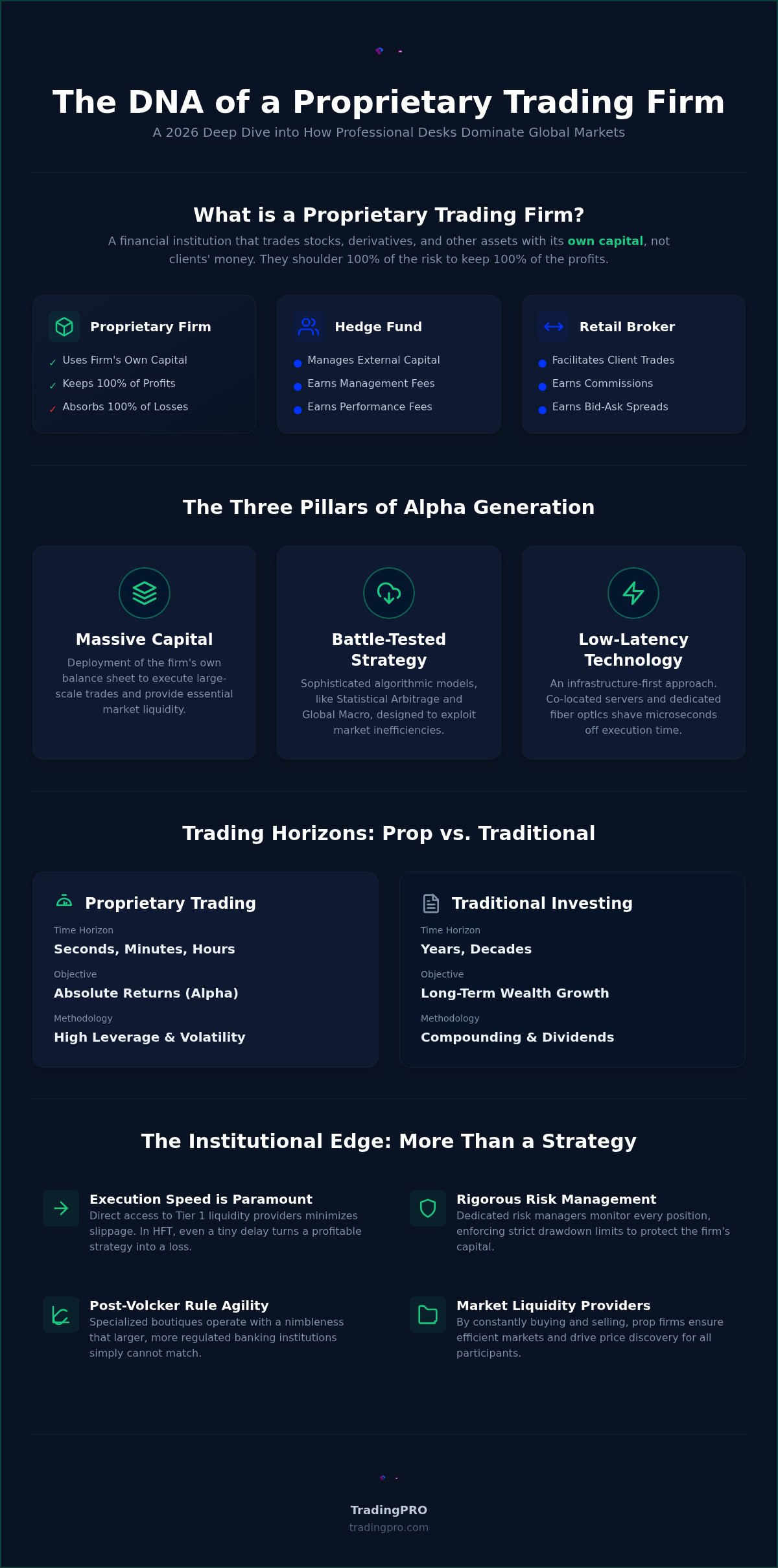
Proprietary trading represents the apex of institutional market activity. When asking what is a proprietary trading firm, the answer lies in the source of the capital. Unlike retail brokerages that act as facilitators for a commission, a proprietary trading firm operates as a principal. The firm invests its own balance sheet for direct market gain. This means the institution keeps 100% of the profits, but it also shoulders the entirety of the risk. While hedge funds manage external capital for a management fee, prop desks use their own treasury to hunt for absolute returns.
The primary objective for these firms is the generation of "Alpha." They seek absolute returns regardless of broader market direction. Whether the global indices are soaring or crashing, a prop firm’s goal remains the same: profit from volatility and price inefficiencies. Beyond their own profit motives, these desks play a vital role in the global financial ecosystem. By constantly entering and exiting positions, they provide essential market liquidity and drive price discovery. They ensure that markets remain efficient and that buyers and sellers can always find a counterparty.
The Core Business Model of a Prop Firm
Profit in this environment flows from capturing the bid-ask spread and correctly timing directional movements. The industry has shifted away from the chaotic shouting matches of physical trading floors toward lean, tech-heavy operations. Modern firms rely on sophisticated algorithmic and High-Frequency Trading (HFT) models. These systems execute massive order volumes in milliseconds, capitalizing on price discrepancies that are invisible to the human eye. Proprietary trading is the pursuit of profit through internal capital deployment.
Prop Trading vs. Traditional Investing
Traditional investing focuses on long-term wealth accumulation and dividend yields over years or decades. Prop trading operates on a much tighter horizon. Positions are often held for hours, minutes, or even seconds. This aggressive model relies on high leverage and rigorous risk management protocols to amplify small price movements into significant institutional gains. Traders focus on multi-asset volatility rather than steady, passive growth. To compete at this level in 2026, you need infrastructure like the Scalp Account, which provides the institutional-grade execution speed required to capture these fleeting opportunities before they vanish.
The Mechanics of a Prop Desk: How Firms Generate Alpha
Prop desks function as high-performance engines built on three non-negotiable pillars: massive capital, battle-tested strategy, and cutting-edge technology. Understanding what is a proprietary trading firm requires looking beyond the charts and into the server rooms. These firms don't just trade; they dominate through execution speed. By utilizing Tier 1 liquidity providers, they ensure every order hits the market with minimal friction. This institutional-grade access allows for best execution, a standard that retail traders often struggle to reach on standard platforms.
Risk management is the backbone of this operation. While traders hunt for alpha, risk managers oversee every position to monitor drawdowns. They act as the firm's fail-safe. This rigorous internal oversight became even more critical following the implementation of the Volcker Rule, which effectively pushed proprietary trading away from commercial banks and into specialized, independent boutiques. Today, these firms operate with a level of agility that larger banking entities simply can't match.
Infrastructure: The Silent Edge
When you grasp what is a proprietary trading firm at its core, you realize it's a technology company that happens to trade. Infrastructure is the silent edge that separates winners from also-rans. Professional desks invest millions in server proximity and dedicated fiber optics to shave microseconds off their execution time. In high-volume environments, even a tiny delay causes slippage that can turn a profitable strategy into a loss. Every millisecond counts. Explore the best trading infrastructure for scalping to understand how speed dictates success.
Common Proprietary Strategies
Alpha generation usually falls into three core categories. Statistical Arbitrage involves identifying and exploiting price discrepancies between correlated assets across global markets. Global Macro focuses on capturing volatility driven by emerging market shifts, interest rate changes, and geopolitical events. Finally, Scalping involves executing a high volume of trades to capitalize on micro-movements within the order book. These strategies require a level of precision and capital that standard retail setups simply cannot offer. If you're ready to deploy your own edge with institutional speed, you can get started with a professional account today and leave retail limitations behind.
Institutional Prop Firms vs. Retail Evaluation Platforms
The definition of what is a proprietary trading firm has split into two distinct universes. In one, you have the institutional titans where elite mathematicians and Ivy League graduates manage billions. In the other, you have the democratized world of retail evaluation platforms. Understanding this divide is critical for any trader looking to scale. While both models involve trading firm capital, the entry requirements, risk structures, and compensation models couldn't be more different. One path offers corporate stability and massive bonuses; the other offers a low barrier to entry but demands absolute precision under strict rules.
Most retail traders are now familiar with the "Funded Account" model. You pay an upfront evaluation fee, pass a multi-stage challenge, and gain access to a funded account. However, a major controversy exists within this space. Many retail prop firms operate entirely in demo environments. They don't always put your trades on the live market. Instead, they pay successful traders using the fees collected from those who fail the evaluation. This simulation model is why these firms enforce rigid daily loss limits and maximum drawdown rules. If you violate a single parameter, your access is terminated instantly.
The Institutional Path: Salaries and Bonuses
The institutional path remains the gold standard for professional stability. To secure a seat at a "Classic Prop" boutique in 2026, you need more than just a good strategy. Firms look for quantitative mastery and proven track records. Junior traders typically start with a base salary and undergo years of rigorous mentorship before they're handed significant capital. It's a high-pressure "eat what you kill" culture, but it's supported by institutional stability and multi-million dollar bonuses for top performers. There are no "evaluation fees" here; the firm invests in you because they believe in your long-term alpha.
The Retail Prop Evolution
The retail prop evolution has democratized access to capital, allowing anyone with a strategy to audition for a professional-grade account. You don't need a degree from MIT to get started. You can begin with a Rookie Account and prove your edge in a controlled environment. The hidden risk, however, is the high failure rate. Most traders fail because they prioritize the "funding" over the infrastructure. In a world of tight drawdown limits, execution speed and low spreads matter more than the account size itself. Success in the retail prop space requires treating your setup with the same technical discipline as an institutional desk.
Navigating the High-Stakes World: Risks and Rewards
Professional trading is a high-octane arena where performance is the only currency. When you ask what is a proprietary trading firm, you're asking about a business built on the razor's edge of risk and reward. High turnover is the industry standard because the pressure to deliver alpha is relentless. Firms don't just provide capital; they demand consistent results. Those who can't maintain the pace are quickly cycled out. This meritocratic environment ensures only the most disciplined traders remain at the helm of institutional funds. It's a world where your value is proven every single day by the bottom line.
Drawdown is the ultimate gatekeeper in this landscape. It's the maximum peak-to-trough decline an account can sustain before the firm pulls the plug. If your equity dips below the predefined threshold, your access to capital is terminated instantly. This mechanism protects the firm's survival, especially during periods of extreme market volatility. This risk is real. Between 2023 and 2024, an estimated 80 to 100 proprietary trading firms closed down due to insolvency or shifting market conditions. Solvency is never guaranteed, making the choice of a stable partner a critical decision for your career longevity.
For those who successfully navigate these waters, the rewards are superlative. Profit splits in 2026 often start at 80% and can scale to 90% for top-tier performers who show consistent growth. You aren't just earning a small commission; you're building a high-performance partnership. This lucrative structure allows elite traders to build significant wealth without risking their own life savings. Understanding what is a proprietary trading firm means recognizing it as a vehicle for massive financial leverage.
Psychological Demands of Professional Trading
Professional trading is a mental marathon. Managing stress becomes a full-time job when you're moving six-figure lots that aren't your own. You must prioritize cold, hard discipline over "gut feelings" or emotional reactions. Successful traders master the psychology of risk to maintain a level head during chaotic market events. There is no room for hesitation. You must execute your strategy with the precision of a machine, regardless of the stakes involved or the size of the position.
Risk Management Protocols
Elite firms don't leave success to chance. They utilize the "Value at Risk" (VaR) model to quantify potential losses with surgical precision. Automated kill switches act as the final line of defense, immediately halting trading activity if risk parameters are breached. This transition from "Rookie" mistakes to professional risk mitigation is what defines a career trader. You must respect the math to survive the market. If you're ready to trade with institutional-grade tools and prove your discipline, register for your professional account today and take control of your financial future.
Scaling Your Edge: Leveraging TradingPRO’s Institutional Infrastructure
Mastering the markets requires more than just knowledge. While you now understand what is a proprietary trading firm, the next step is securing the technical firepower to compete with them. TradingPRO serves as the bridge between retail limitations and institutional dominance. We provide the high-speed, multi-asset environments that were once the exclusive domain of elite desks. If you want to trade with the same precision as a professional, the Scalp Account offers the low-latency infrastructure required to capture micro-movements with absolute confidence.
We treat your growth with the same gravity as a corporate partner. Our account structure follows a career-like progression. You can begin with a Rookie Account to prove your consistency before scaling into Micro, Pro, and Scalp tiers. This modular approach ensures you never outgrow your infrastructure. You get the capital access you need when your performance warrants it. It's a results-driven ecosystem designed for those who refuse to settle for average. We provide the tools; you provide the edge.
Professional Tools for the Modern Trader
Success in the proprietary space requires more than just a basic chart. You need institutional-grade analytics to stay ahead of the curve. Access the Trade Hub for deep-market insights and real-time data that informs your every move. Zero-spread environments are the non-negotiable prerequisite for proprietary-style scalping. Without them, your edge is slowly eroded by execution friction. We offer multi-asset access across Forex, Commodities, and Indices in one unified place. This allows you to hunt for volatility wherever it appears, ensuring you never miss a high-probability setup.
Replicating Success via Social Trading
Proprietary-grade results don't always require you to be the one pulling the trigger. Our Social Trading ecosystem allows you to replicate professional alpha without the barriers typically found when asking what is a proprietary trading firm and seeking a physical seat. Follow Master Traders who demonstrate institutional discipline and mirror their success in real-time. You can build a diversified, prop-style portfolio by leveraging our global network of elite performers. For a deeper dive into these mechanics, explore our comparison of Social Trading vs Copy Trading to find the best fit for your specific goals.
Dominate the Next Market Cycle
The transition from a retail enthusiast to a professional powerhouse requires more than just a strategy change. It demands a total shift in infrastructure. You've uncovered what is a proprietary trading firm and how these elite desks leverage massive capital and lightning-fast technology to generate alpha. In 2026; the gap between institutional and retail trading is closing for those who choose the right partners. You no longer need a physical seat on a trading floor to access the tools that define the big leagues.
Take command of your financial future today. Access execution speeds under 30ms and protect your capital with Negative Balance Protection across all account tiers. Whether you're scaling your own edge or replicating verified Master Traders through our Social Trading network, the power to win is within your reach. It's time to trade with the confidence of a global leader and the precision of a seasoned authority. Scale your trading with institutional-grade infrastructure at TradingPRO and leave retail limitations in the past. Your high-performance career starts now.
Professional Insights: Proprietary Trading FAQ
Do I need a license to work for a proprietary trading firm?
No, you typically don't need a personal license to trade for a retail-facing proprietary firm. These firms operate by providing you with a platform and capital under their corporate umbrella. If you're looking at what is a proprietary trading firm in a traditional institutional sense, like a bank desk, you would need specific regulatory certifications. For retail-facing models, your performance on the platform is the only credential that matters.
What is the difference between a prop firm and a hedge fund?
The primary distinction lies in the source of capital. Proprietary firms trade their own internal treasury for 100% of the gains. Hedge funds are investment vehicles that manage money for external clients, charging management and performance fees. A prop firm acts as the principal in every transaction, while a hedge fund acts as a fiduciary. This allows prop firms to be more aggressive with leverage and specialized strategies.
Can beginners join a proprietary trading firm in 2026?
Yes, beginners can enter the space through structured progression paths. You can start with a Rookie Account to build your skills in a controlled, professional environment. While institutional desks require elite degrees, the modern retail prop model values results over resumes. You can audition for capital by proving your strategy works. It's about demonstrating discipline and risk management before scaling to professional-grade tiers like a Scalp Account.
How much do proprietary traders make on average?
These are two different concepts. Proprietary trading is a business structure where a firm provides capital to traders. Day trading is a specific style where positions are opened and closed within the same session. While many prop traders are day traders or scalpers who utilize high-speed infrastructure, the firm itself is the entity providing the capital. You can be a prop trader who holds positions for longer durations.
What are the most common assets traded by prop firms?
Most firms focus on high-liquidity markets that offer consistent volatility. This includes major Forex pairs, global Indices, and Commodities like Gold or Oil. Firms prioritize these assets because they allow for large position sizes with minimal slippage. At TradingPRO, we provide a multi-asset environment across these categories. We do not offer physical share ownership or cryptocurrency wallet services, focusing instead on professional-grade market execution.
How do prop firms handle losses?
Firms handle losses by absorbing the financial hit to their own capital. The trader is not personally liable for the losses beyond their initial evaluation fee or deposit. However, firms use strict drawdown limits to protect their treasury. If you hit a maximum loss threshold, your access to the capital is terminated. We offer Negative Balance Protection across all tiers to ensure your losses never exceed your initial deposit.
Are 'funded account' prop firms legitimate?
Legitimacy varies across the industry. While many firms provide genuine opportunities to trade large capital, others operate as demo-only environments that profit solely from failed evaluation fees. To verify what is a proprietary trading firm in terms of reliability, look for institutional-grade execution speeds and a transparent payout history. A legitimate partner provides the infrastructure you need to succeed, such as the high-performance environment found in a Scalp Account.


